


Repeat. Refine. understand
not as a choreography, but as a living practice.
These workshops are an offering for those who have already learned the choreography of the Wu Ma TaiJi Slow Form and want to receive corrections and learn more about the principles beyond it. It is for those who want to learn how to practice correctly.
Taking a closer look at movements
Second stage of learning
- Starting to refine and integrate the principles of movement
- Understanding their application and energetics
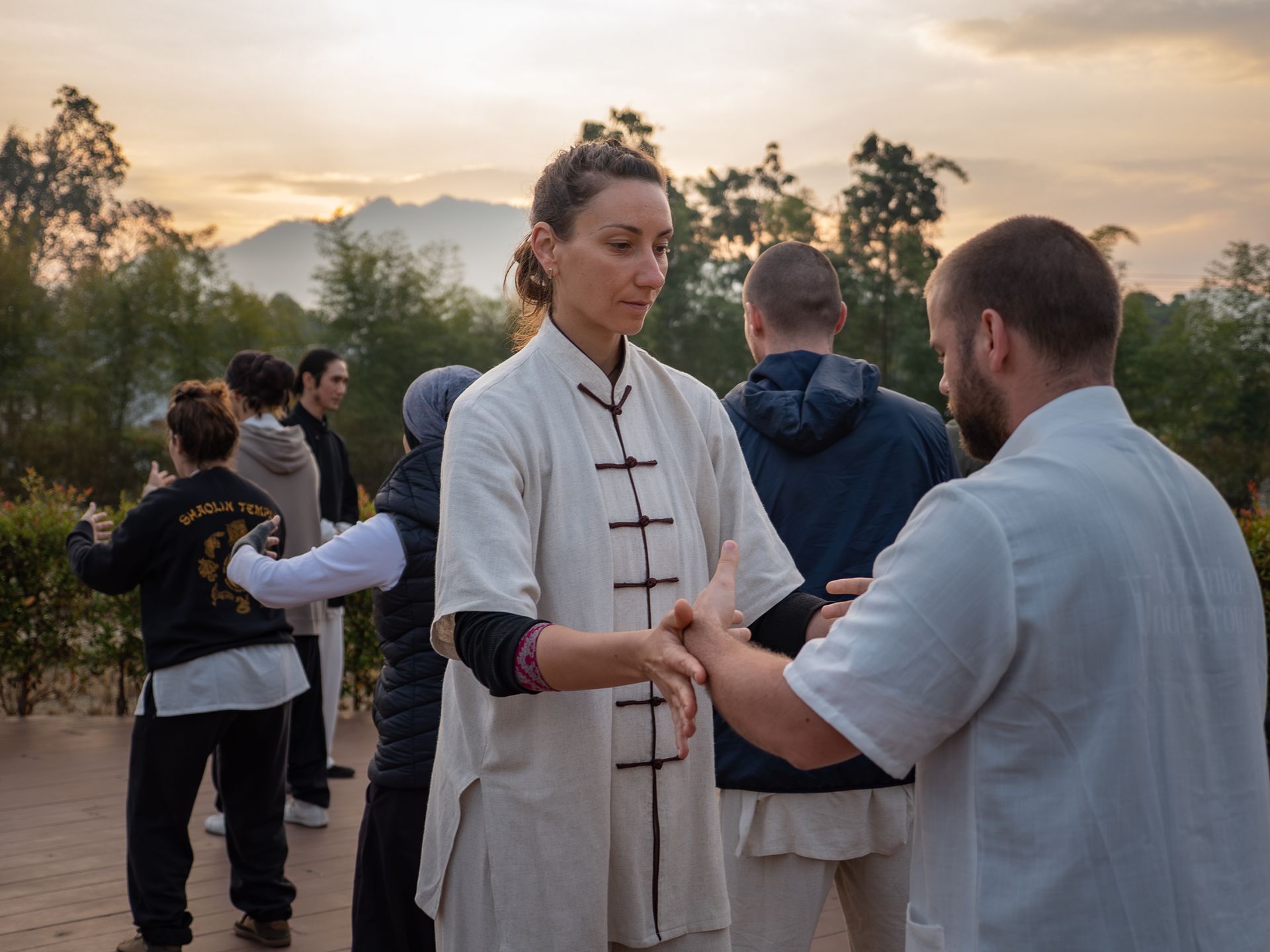
- Testing them with partner exercises (TuiShou)
- Opening the physical body on deeper levels in order to prepare it for the natural unfolding of TaiJi.
We will take time to go deep within the body and work with its tensions.
We will take time to correct and refine our form, taking a closer look at the energy movement within.
We will take time to practice deeply and learn how to integrate the TaiJi principles into our everyday life.
Instead of adding more to our already existing practice, we soften, listen, adjust, and allow the practice to reveal greater depth. Through careful repetition and clear guidance, familiar forms begin to feel different: more connected, more alive, more effortless, more full.
Content
Fang Song Gong - Tension Release Exercises
TaiJi Form Corrections - Alignment and Structure
Body Opening - Stretching and Joint Opening
Qigong - Energy Cultivation
TuiShou - Partner Exercises
The 6 Day Journey
Monday - Arriving
Stepping out of daily routine and into our body.
The first day we come together and simply move. We will focus on releasing the impressions and tensions of everyday life and making space for our awareness to come back home. Back to the body. Back to the present moment.
Tuesday - Remembering
The second day we will repeat and correct what we have learned. We will remember movements and principles already known and check the basic physical frame and structure within the forms and exercises.
Wednesday - Body Opening
On the third day we will spend more time with body opening and awareness practices which can support the development of our energy body and our ability to sense tensions and release (Song) them, learning practical ways to help our body soften up.
Thursday - Refining
On the fourth day it is time to begin diving into a deeper layer, taking a look at the correct principles of movement. We will deepen our understanding of Song (Yin), Stretch (Yang) and the play of balance in between them (TaiJi). We will start to develop a feeling for moving in a connected way, speaking more about energy and less about external form.
Friday - Unveiling
As the practice routine begins to settle into a state of opened awareness, we will begin to discover how the TaiJi principles can be found in all daily movements and moments. We will explore further how these apply to our life and how we can move through life in accordance with the laws of nature (Dao).
Saturday - Integration
The last day is a day to revise our experience during this week and to start integrating our practice mind with our everyday mind, so that our transformation can become a meaningful and valuable tool for personal growth. We will take time to clear out any doubts and uncertainties about how and what to practice, creating a good structure and clear intention. For those who have walked this path with us for longer time, this is your next step.
After learning the form, the real practice begins.
The Teaching
The WuMa TaiJi lineage carries a rich tradition passed down through generations, descending from Master Ma Jiangbao and transmitted through his close personal disciple (Tudi), Sifu Jürgen Meyer. Rooted in the Wu-style family tradition from Shanghai, this lineage emphasizes precise body alignment, effortlessness, and the internal cultivation of Qi through core principles.
Under the guidance of Shifu Zuan and Team JIO, the teachings offer a direct and structured path—from foundational forms to advanced internal practice—connecting modern practitioners to the deep wisdom and living heritage of the ancestors.
This practice is not about achieving something or becoming someone else. It is about learning to listen again—to the body, to ourselves, and to what is naturally present.
